How to efficiently machine shaped parts on CNC mill-turn machines?


Manufacturers widely use solid carbide milling cutters to machine blades for the energy and aerospace sectors.
These blades are typically made from difficult-to-machine materials such as stainless steel, titanium alloys, or high-temperature alloys.
In the machining process for blades in these industries, both the blade geometry and surface finish quality are subject to stringent requirements.
When machining these difficult-to-cut materials, tools are prone to multiple issues.
They may suffer from chipping and wear.
High cutting temperatures can easily develop.
Tools may also harden during the process.
Significant cutting vibrations often occur.
These problems result in poor workpiece surface quality.
Since the tool is the component directly interacting with the workpiece during blade production, its design directly impacts both machining quality and efficiency.
This paper focuses on developing an integral carbide close-pitch cutter for energy turbine blade machining.
The designers specifically aim the design at surface machining.
It targets gas turbine blades made from B50A789F stainless steel.
Researchers validate the reliability of the tool design through tool design and cutting performance research.
The cutting edge geometry is shown in Figure 1.

The manufacturing process for gas turbine blade surfaces typically follows the sequence: casting → milling → polishing.
Blade manufacturing requirements demand not only precise shape but also high surface quality.
Based on customer site specifications, operators generally control the surface roughness value for the milling process at Ra ≤ 3.2 μm, while the polishing process typically achieves Ra ≤ 0.8 μm.
If the surface roughness of gas turbine blades is too high, it intensifies heat transfer intensity on both the pressure and suction sides of the blade.
Simultaneously, it increases friction between the fluid and the blade surface, thereby enhancing convective heat transfer.
The resulting rise in the average metal surface temperature of the gas turbine blades significantly impacts blade lifespan.
Additionally, a rough blade surface increases the surface area, providing more heat transfer area.
This may also heighten the risk of corrosion and wear on the blade, thereby affecting its service life.
The design of close-pitch cutters for blade profile machining must meet strict requirements.
First, the machined blade profile must achieve dimensional accuracy.
Second, operators must control the surface roughness to Ra ≤ 3.2 μm.
Additionally, the cutting tool must prevent overheating during machining to preserve tool life and maintain processing efficiency.
Based on these considerations, the design of solid carbide close-pitch cutters primarily focuses on four aspects: tool material selection, geometry optimization, manufacturing process refinement, and surface coating design.
The blade material is B50A789F steel, a commonly used material for manufacturing gas turbine compressor blades and guide vanes.
B50A789F steel shares similar compositional characteristics with 04Cr15Ni7Cu2MoNb alloy structural steel.
It belongs to the precipitation-hardening martensitic stainless steel category.
Its strengthening mechanism primarily relies on age hardening of copper-rich phases and precipitation strengthening from molybdenum and niobium.
Based on the machinability characteristics of B50A789F steel, cutting tools must meet the following requirements during manufacturing and machining:
① High hardness to withstand plastic deformation of the substrate during manufacturing and cutting.
②Engineers design the tool with high strength to withstand high-speed cutting and heavy loads in production environments.
③ High wear resistance to maintain edge sharpness during cutting.
④Manufacturers can produce the cutting edge radius to a small value.
To meet these requirements, tool materials should feature fine grain size, high toughness, and excellent thermal conductivity.
This enables efficient heat dissipation from the cutting edge region, reducing cutting temperatures while maintaining superior wear resistance.
During blade surface machining, tools exhibit minimal wear and chipping, ensuring high surface finish quality.
Solid carbide is a suitable material for machining stainless steel, with submicron-grain materials (0.6μm grain size) being ideal for milling stainless steel.
Figure 2 shows the metallographic structure of the solid carbide close-pitch cutter, and Table 1 lists the tool material composition and physical properties.


(1)Designers adopt a close-pitch design for gas turbine blade surface milling operations.
The advantage of this configuration lies in its ability to distribute cutting forces during machining.
A higher number of teeth reduces the cutting force per tooth, resulting in superior surface finish quality for the blades.
Typically, standard flat-end milling cutters feature 3–4 cutting edges.
For solid carbide close-pitch cutters, manufacturers generally select the number of cutting edges based on the tool’s outer diameter, typically ranging from 10 to 12 edges.
Excessive cutting edges (especially on small-diameter tools) may compromise individual cutting edge strength and chip evacuation space.
Considering all factors, selecting 10 to 12 cutting edges for solid carbide close-pitch end mills is optimal.
This ensures the tool experiences lower cutting forces during machining while maintaining adequate cutting edge strength and chip evacuation space.
(2) Tool Tip Radius Solid carbide close-pitch tools are used for machining B50A789F steel, a material characterized by high plasticity and toughness.
During cutting, chips readily adhere to the tool edge surface, impairing edge sharpness and causing accelerated wear.
Once rapid edge wear occurs, tool vibration during cutting generates surface ripples on the blade.
The worn cutting edge then scratches the blade surface, leading to deviations in blade contour accuracy and surface quality inspections.
To address this issue, the overall solid carbide close-pitch cutter design incorporates a rounded corner at the cutting edge.
This effectively protects the tip, reduces tool wear during machining, and produces a smooth blade surface with minimal burrs.
However, excessive tip radius can dull the tool, shortening its cutting life.
Therefore, a reasonable radius design effectively protects the tip, reduces wear during cutting, and improves the surface quality of the machined blades.
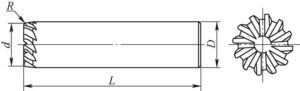
Engineers select the tip radius for solid carbide close-pitch cutters between R0.5 mm and R1 mm, considering the tool diameter and number of cutting edges.
The tool structure is shown in Figure 3.
Tool manufacturing technology encompasses two primary areas: tool preparation programming and simulation, and grinding process optimization.
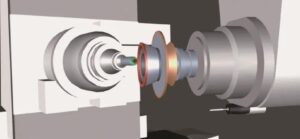
The tool grinding programming demonstration is shown in Figure 4.
For programming the solid carbide close-pitch cutters in this paper, engineers import the tool design drawings into parameterized preparation software.
Engineers establish a CAM model for tool preparation based on design parameters and perform grinding simulation using simulation software.
The designed tool undergoes grinding on a five-axis tool grinder, utilizing specialized CAM software for tool grinding to perform modeling and simulation.
Furthermore, engineers considered the high demands for dimensional accuracy and surface quality of solid carbide close-pitch cutters.
The existing tool grinding process was then investigated.
Engineers optimized and validated key parameters such as grinding wheel cross-section shape, mounting angle, grit count, and grinding passes.
This ensured strict adherence to process requirements during tool manufacturing, thereby guaranteeing dimensional precision and surface finish.
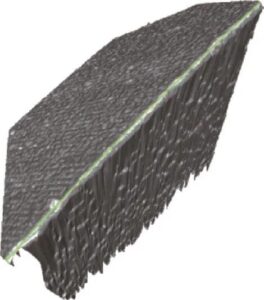
The three-dimensional demonstration of the tool edge profile is shown in Figure 5.
After grinding, the tool edge undergoes contour scanning, revealing a smooth transition with no burrs or micro-chipping.
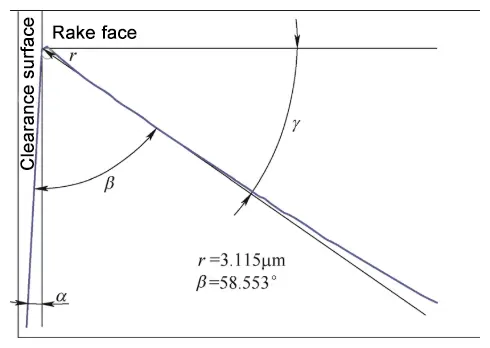
The tool tip radius inspection, as shown in Figure 6, indicates a smooth transition at the tool tip radius.
This demonstrates that the manufacturing of solid carbide close-pitch cutters meets design requirements.
Manufacturers apply surface coating treatment to enhance tool cutting life, increase surface hardness, and improve high-temperature and wear resistance.
This treatment is used on solid carbide close-pitch tools machining B50A789F stainless steel.
The selected coating is AlTiN (aluminum-rich), a versatile coating.
Increasing the aluminum content in AlTiN maintains its crystal structure while further improving oxidation resistance and high-temperature mechanical properties.
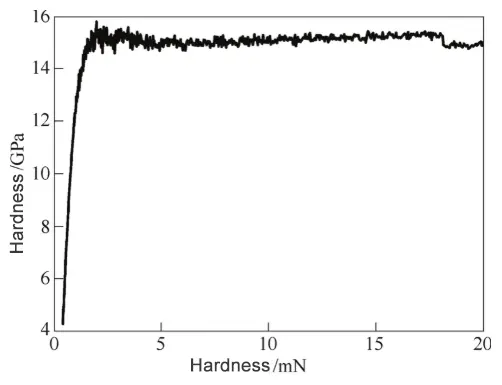
The microhardness load-deformation curve of the AlTiN coating is shown in Figure 7.
At a maximum indentation load of 20 mN, the coating’s hardness curve remains within the high-hardness plateau region.
It exhibits a hardness of 38.3 GPa and an elastic modulus of 305 GPa.
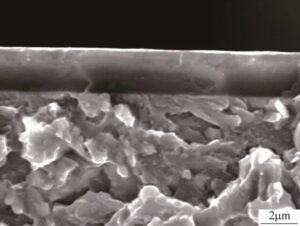
The SEM image of the cross-sectional fracture surface of the AlTiN coating is shown in Figure 8.
Researchers observed that the coating exhibits fine grains with a smooth fracture surface and no columnar crystal structure, indicating a nanocrystalline structure.
The performance parameters of the AlTiN coating are listed in Table 2.

The investigation into the cutting performance of solid carbide fine-tooth cutters was primarily conducted on machining centers at user sites.
A D20mm tool with a 12-flute cutting edge and a 1mm tip radius was selected.
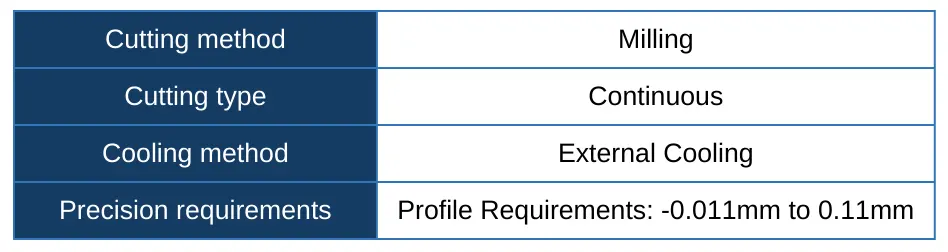
Tool cutting conditions are detailed in Table 3, while cutting parameters are listed in Table 4.

Technicians machine blades on-site for a specific gas turbine model. **They** prepare the blades as forgings made of B50A789F steel before milling.
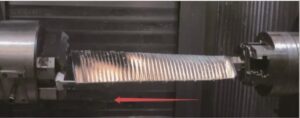
The user’s on-site blade clamping setup is shown in Figure 9.
Solid carbide close-pitch cutters are primarily used for milling the blade profile surfaces.
The milling process proceeded smoothly with no noticeable machine vibration.
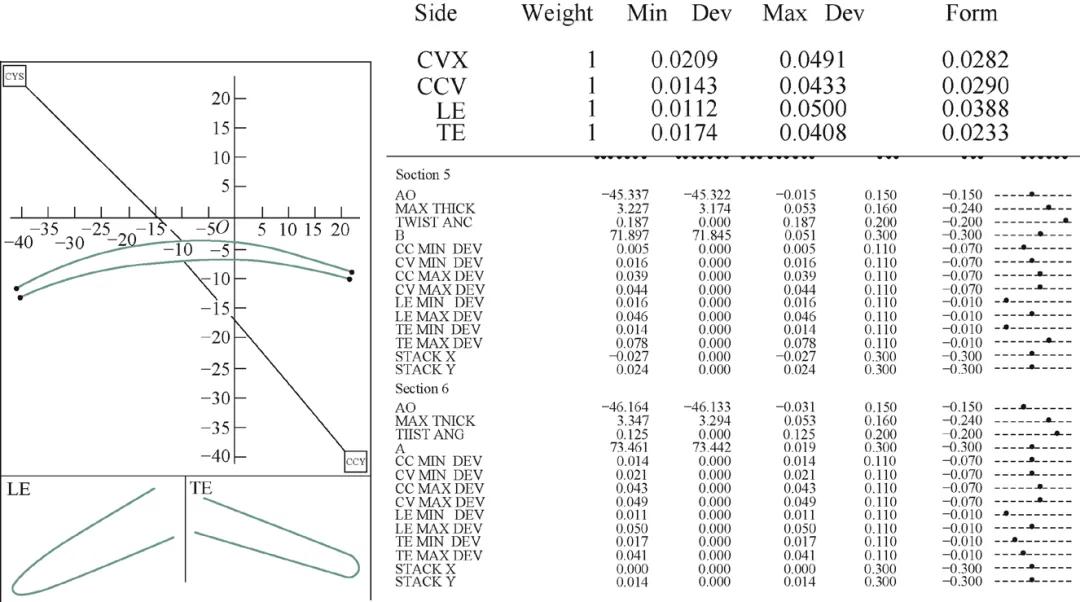
Post-milling surface profile measurements were conducted using a coordinate measuring machine (CMM).
The actual data ranged from 0.023 to 0.038 mm, meeting customer dimensional requirements.
Inspectors present the CMM inspection report for the blade profile in Figure 10.
Additionally, the surface roughness value Ra of the blades is ≤3.2μm, with no defects such as burrs or scratches affecting surface quality.
The milled blade surface is shown in Figure 11.

The developed solid carbide close-pitch cutter can continuously machine two blades, meeting user requirements for both dimensional accuracy and surface finish.
Furthermore, after machining two blades, the cutting edge exhibited no defects such as coating peeling or chipping that would affect tool life.
Therefore, the development of this solid carbide close-pitch cutter for gas turbine blade profile machining is deemed successful.
Field cutting tests were conducted at the user’s site.
They demonstrate that the solid carbide close-pitch cutter delivers stable cutting performance with no machine vibration.
Within its effective machining length range, the tool exhibits reasonable edge wear.
The dimensional accuracy and surface finish of the machined blades meet cutting requirements.
This demonstrates that using submicron-grain cemented carbide material and applying an AlTiN coating to the tool surface improves performance.
Engineers observe that the solid carbide close-pitch cutter resists high temperatures and surface wear during blade machining, effectively reducing surface friction.
The close-pitch multi-edge design with rounded tool tips minimizes cutting resistance and maintains stable cutting performance.
During manufacturing, specialized CAM software was employed for modeling and simulation.
Combined with optimized grinding processes, this ensured the tool meets design specifications.
This monolithic carbide close-pitch tool design satisfies the machining requirements for B50A789F steel gas turbine blades.
It is therefore an ideal cutting tool for gas turbine blade processing.